
Reflections on Game Accessibility
0 Comments Published by OneSwitch.org.uk on Tuesday, January 18, 2011 at 4:58 PM.


The January 2011 IGDA Perspectives newsletter contains a two page segment on the 'game accessibility year' 2010, from my own personal perspective. If 2011 tops 2010, consider me a happy-bunny.
Big chunky thanks to the IGDA, and especially to Beth Aileen Lameman for giving Game Accessibility such great coverage.
Labels: articles, IGDA GASIG
"Are Wii Being Ignored?"
1 Comments Published by OneSwitch.org.uk on Tuesday, August 10, 2010 at 3:16 AM.
 BBC Ouch! technology correspondant, Adrian Higgin-botham, has written a harsh but fair appraisal of the state of accessible gaming. In short, AAA 21st century video games don't have much in the way of accessibility features. And those rare games that are highly accessible, tend not to have the budget, depth or production values of AAA titles. Come on the mainstream, you are slacking!
Image via: David G on the Ouch! Forums
Labels: articles, Campaigning
Game Accessibility: A Survey
0 Comments Published by OneSwitch.org.uk on Tuesday, July 6, 2010 at 2:30 PM.

For those interested in: 1) a comprehensive overview of academic literature on game accessibility; 2) a synthesis of strategies used to make games for sensory, motor and cognitive impairments; and 3) data on how many people in the US are unable or limited in playing video games per type of impairment, a journal paper called: "Game Accessibility: a Survey" written by Bei Yuan, student of IGDA GASIG member, Eelke Folmer, is available online.
If you would like an offline copy of this paper, and you don't have access through a university library, please contact Eelke direct.
Labels: academic papers, articles
Accessibility: Creating Games For A Diverse Audience
0 Comments Published by OneSwitch.org.uk on Tuesday, October 6, 2009 at 3:37 PM.
 Meagan Van Burkleo of Game Informer has posted an excellent break down of what many disabled gamers want from their games. Giving importance to all four broad divisions of disability: Physical (including speech), Cognitive, Sight and Hearing, this is a really good account and well worth your time.
Labels: articles
 Game Set Watch published a piece recently by Leigh Alexandra entitled 'Analysis: Can Nintendo Take 'Accessibility' Too Far?'. It questions if accessibility features spoil gaming. A depressing stand point and one that I feel misinterprets what greater accessibility can really mean.
Info with thanks to: Scott McKay
Labels: articles
Videojuegos Accesibles: Porqué Y Cómo Hacerlos
0 Comments Published by OneSwitch.org.uk on Thursday, June 11, 2009 at 4:51 PM.
 "Videojuegos accesibles, porqué y cómo hacerlos" which translates to "Accessible Videogames, why and how to develop them". Javier Mairena, a software developer with special interest in accessible videogames development, has written this fine article to reach out in the third most spoken language in the world.
I love receiving news of accessibility work from other parts of the world even when in a language I little understand. The desire for opportunities to play doesn't change around the world whatever the language.
Via: IGDA GASIG Mailing List. See more international articles here.
Labels: articles
Video Game Accessibility: The 1970's
0 Comments Published by OneSwitch.org.uk on Sunday, May 24, 2009 at 4:48 PM.
 AbleGamers have uploaded my first article for them: A Brief History of Video Game Accessibility: The 1970's. Starting with 1971's Computer Space this article is a trek through the very origins of game accessibility. "Can you dig it?".
Labels: articles, Historical
7-128.com: Top Accessible Gaming Sites Lists
1 Comments Published by OneSwitch.org.uk on Monday, February 16, 2009 at 6:02 PM.
 7-128.com have just published three top accessible gaming sites lists: Top 25 Web Sites for Gamers who are Blind; Top 20 Web Sites for Gamers who are Motion Impaired and Top 10 Web Sites for Gamers who are Deaf.
Fantastic image via Flickr.
Labels: Accessible Gaming Sites, articles
Global Assisitve Technology Wiki
2 Comments Published by OneSwitch.org.uk on Wednesday, February 11, 2009 at 4:09 AM.
 AbilityNet have put together a wonderful open project called the Global Assisitve Technology Wiki or GATE for short. In their words:
A really good place to start is their Switch Systems entry here. They are lacking their own accessible games section so hopefully someone (maybe me) will take up the gauntlet for that soon."GATE is actually a Wiki, which is a piece of server software that allows users to freely create and edit Web page content using any Web browser. It's a little like Wikipedia, but just concentrating on assistive technology. GATE is very simple to use, with a control panel enabling you to add content and more. More about Wikis . . .
This wiki has been created by AbilityNet, the UK's largest provider of advice and information on all aspects of Access to technology. The purpose of the wiki is to provide live and up to date information on all aspects of Assistive Technology."
Labels: Accessible Controllers, articles
360 Magazine - "The Forgotten Gamers?"
0 Comments Published by OneSwitch.org.uk on Monday, November 17, 2008 at 6:02 AM.
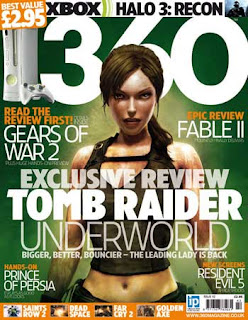 Alice Bonasia has written a fine six-page article on the state of game accessibility as represented by the Xbox 360 magazine - "360".
It opens: "As the games industry continues to look for that elusive 'Blue Ocean', is it actually missing a core gaming audience that not only enjoys games but also enjoys significant improvement in its quality of life because of them? 360 investigates gamers with disabilities and what's being done to incorporate them."
It closes: "It does seem strange, to say the least, that with all the talk of breaking into new markets and wooing new audiences to gaming, the industry steadfastly ignores a ready-made audience that asks for nothing more than to be able to play these games. Disabled gamers seem to be one of the last great untapped audiences, and leaving them behind could be, if nothing else, a very costly mistake".
Whet your appetite? Then support the supporters and order yourself a copy from Imagine Publishing. Alternatively if you're in the UK, they're on the shelves now at £2.95 a copy.
Labels: articles
The Escapist: The Silent Majority
0 Comments Published by OneSwitch.org.uk on Tuesday, November 11, 2008 at 5:26 PM.
 "It's not that hard to understand the plight of the deaf gamer - just try playing Dead Space with the sound turned off.
EA's new sci-fi horror game is a showcase for big-budget production values, seething with smoky atmosphere and gory detail - all in the service of scaring the shit out of you. It's obvious that the publisher spared no expense. EA produced a comic book series. It released an animated movie prequel. It localized for Polish speakers.
Step onto the deck of USG Ishimura without the aid of headphones or speakers, however, and the game falls apart. Without sound, you don't hear music cues, the swell of dissonant strings that alerts you to danger. Without sound, you don't hear the monster leaping out of the ventilation duct behind you. Without sound, you don't hear the whiz of passing poison darts, much less where they're coming from.
Dead Space without sound is fundamentally broken..."
Read the rest of this excellent article at The Escapist: The Silent Majority.
Labels: articles, Deaf Gamers
 Aisrael.org have a pretty thorough three part article on game accessibility in Hebrew. It covers physical disabilities and solutions, moving onto barriers facing visually impaired and blind gamers onto deaf gamers. Part 1, Part2 and Part 3 all here.
Labels: articles
 "Off-the-shelf designs are especially frustrating for the disabled, the elderly and anybody who has trouble controlling a mouse. A new approach to design, developed at the University of Washington, would put each person through a brief skills test and then generate a mathematically-based version of the user interface optimized for his or her vision and motor abilities. A paper describing the system, which for the first time offers an instantly customizable approach to user interfaces, was presented today in Chicago at a meeting of the Association for the Advancement ofArtificial Intelligence."
The full story can be found: http://uwnews.org/article.asp?articleID=42817
Via: John Bannick of 7-128 Software on the IGDA GASIG Mailing List.
Labels: Accessible Controllers, articles
 AbleGamers have posted a two part interview they and GASIG chair Michelle Hinn made with Popcap Games' Garth Chouteau in the light of their recent Casual Games survey. Grab your self a cup of tea, and read on... Part one here, and Part two here.
Labels: articles
 Game Developers want statistics - although probably not my favourite statistic that 88.2% of all statistics are made up on the spot (Vic Reeves).
Computer Shopper: Disabled People Prescribed Gaming
PopCap Games Study: Casual Video Games Demonstrate Ability to Relieve Stress, Improve Mood: Potential Clinical Significance Highlighted
Eelke Folmer: Statistical Research
Via: IGDA GASIG Mailing List
Labels: articles, Statistics
Leaving in “god mode” game codes
0 Comments Published by OneSwitch.org.uk on Tuesday, June 17, 2008 at 4:50 PM.
 Wazoo Enterprises states the importance of cheat codes within games in a very succinct way. Not 100% sure of the language used (I'm no fan of "special needs" as a term) - but I'm 100% behind the sentiment.
Via: Mersey Remakes
Labels: articles
"20% of casual gamers are disabled"
0 Comments Published by OneSwitch.org.uk on Monday, June 16, 2008 at 4:01 AM.

More than one fifth of casual gamers have a “physical, mental or developmental disability” according to a new survey commissioned by PopCap.
The research, carried out by the Information Solutions Group, involved responses from 13,296 casual gamers, and also found that only 26 per cent of disabled casual gamers were said to play traditional video games.
Depression, ADD / ADHA and Rheumatoid Arthritis / Osteoarthritis ranked as the most common types of conditions amongst casual gamers.
The study found that those with disabilities typically play casual games more frequently and longer than non-disabled consumers, and find the benefits to include stress release, mood lifting, and "distraction".
"Games like Bejeweled and Peggle, with simple controls that are also mentally challenging and engaging are ideal for me, because my mind moves as quickly as the next guy's but I type with a mouth-stick," noted 58-year-old Gary Robinson, who is described as having "severe physical disabilities."
"In some ways, games like these are the greatest thing that's appeared on the computer scene for people like me," he added.
The topline data from the report was as follows:
Most Common Disabilities Physical (46% overall)
+ Rheumatoid Arthritis/Osteoarthritis (14%)
+ Fibromyalgia (11%)
+ Multiple Sclerosis (7%)
Mental (29% overall)
+ Moderate/Severe Depression (41%)
+ Bipolar Disorder (16%)
+ Anxiety Disorder (15%)
Developmental/Learning (25% overall)
+ ADD/ADHD (46%)
+ Autism (15%)
+ Dyslexia (11%)
Most Common Perceived Benefits Physical
+ Stress relief (84%)
+ Distraction from disability issues (73%)
Mental
+ Stress relief (87%)
+ Mood-lifting (78%)
Developmental/Learning
+ Improved concentration (79%)
+ Improved coordination/manual dexterity (73%)
Via: CasualGaming.biz and Ernest Adams
Labels: articles, Statistics
The Case for Gaming Accessibility
0 Comments Published by OneSwitch.org.uk on Sunday, June 8, 2008 at 5:34 PM.
 A Case for Gaming Accessibility is made in Eitan Glinert's work - "The Human Controller: Usability and Accessibility in Video Game Interfaces".
"Despite the advances in user interfaces and the new gaming genres, not all people can play all games - disabled people are frequentlyexcluded from game play experiences. On the one hand this adds to the list of discriminations disabled people face in our society, while on the other hand actively including them potentially results in games that are better for everyone. The largest hurdle to involvement is the user interface, or how a player interacts with the game. Analyzing usability and adhering to accessibility design principles makes it both possible and practical to develop fun and engaging game user interfaces that a broader range of the population can play. To demonstrate these principles we created AudiOdyssey, a PC rhythm gamethat is accessible to both sighted and non-sighted audiences. By following accessibility guidelines we incorporated a novel combinationof features resulting in a similar play experience for both groups. Testing AudiOdyssey yielded useful insights into which interface elements work and which don't work for all users. Finally a case is made for considering accessibility when designing future versions of gaming user interfaces, and speculative scenarios are presented for what such interfaces might look like."
Labels: articles
"Player vs. Everything: Gaming with a disability"
0 Comments Published by OneSwitch.org.uk on Wednesday, June 4, 2008 at 9:46 AM.
 Great interview with AbleGamers over at MMORPG site Massively. Well worth a peek.
Labels: Accessible Gaming Sites, articles
 Some excellent recent articles regarding game difficulty levels:
Pushing Buttons: The Difficulty Bandwagon
The Escapist: Hard Times
Gamasutra: The Designer's Notebook: Difficulty Modes and Dynamic Difficulty Adjustment
Via: Mersey Remakes
Labels: articles
